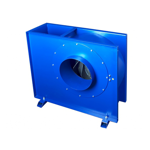
Fans

Fans are basic components of all ventilation systems and equipments. We offer fans for use in simple applications such as toilet or bathroom ventilation but also for complex ventilation of family houses, industrial halls, aggressive environments in the chemical industry, laboratories etc. Fans are fundamentally divided to axial and radial depending on the impeller design. Fully configurable fans are also an integral part of our offer, thanks to which we meet every requirement of our customers.
Small axial fans
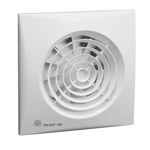
Small axial fans are the most suitable and most common solution for ventilation of toilets, bathrooms and smaller rooms. The most used variants: overrun timer / humidistat / window version. The small axial bathroom extractor fans are designed for short air ducts with low pressure drop or for ventilation directly through walls.
Small centrifugal fans
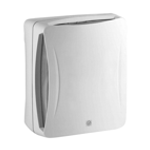
Fans - circular duct

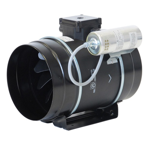
Circular duct fans are suitable for central ventilation of commercial buildings, family houses, sanitary facilities or workshops. In the category of circular duct fans there are all types of fans - axial, radial, diagonal - which have a neck in circular diameter. The best-selling types for residential buildings are the TD Silent, the TD Mixvent and RVK fans, which thanks to their plastic construction achieve very favourable noise parameters. For industrial applications with relatively higher pressure loss, the RM or KD fans are most often used.
Fans for circular ducts – professional solutions for modern ventilation systems
Fans for circular ducts (also known as "duct fans" or "channel fans") are a key component of forced ventilation systems. They are used for air extraction and supply in apartments, family homes, offices, commercial premises, and light industry. They are installed directly into circular HVAC ducts and help maintain stable air flow even with higher pressure losses (elbows, dampers, grilles, filters).
Our range includes axial duct fans for shorter and simpler routes, as well as radial (centrifugal) duct fans, which are suitable for applications requiring higher pressure. For economical operation, we recommend EC duct fans with continuous control, while classic models with AC motors are an affordable and proven solution for common applications.
Quick orientation by application
- Fans – category overview
- Axial duct fans (shorter routes, lower pressure losses)
- Radial duct fans (higher pressure, longer and more complex distribution systems)
- EC duct fans (energy-efficient operation, smooth control)
- Silent duct fans (residential areas, low noise)
- Accessories (regulators, dampers, noise dampers, grilles)
Main advantages of duct fans
- Easy installation in circular ducts – direct connection to HVAC distribution systems.
- Wide range of applications – bathrooms, toilets, kitchens, offices, warehouses, technical rooms, and commercial spaces.
- Speed control option – for optimizing flow (m³/h), pressure (Pa), and noise (dB(A)).
- Stable performance even with pressure losses – suitable for longer and more complex ducting routes.
- Energy savings – especially with EC fans with continuous control.
Decisive technical parameters
For the right choice, pay particular attention to air flow (m³/h), static pressure (Pa), duct diameter (Ø), noise level and control method. If the system has multiple elbows, dampers, filters, or a longer route, the pressure loss increases – in such cases, a radial solution or a more powerful model is usually more suitable.
Most frequently searched parameters
- Duct diameters: Ø 100 / 125 / 150 / 160 / 200 / 250 / 315 mm (depending on model)
- Air flow: depending on the specific fan and pressure losses in the system
- Pressure: particularly important for longer routes, filters, grilles, and elbows
- Power supply: 230 V (AC/EC) or 400 V (3f for selected variants)
- Control: voltage, frequency converter, 0–10 V (EC), external controllers
Speed control and operating comfort
Control is important for achieving the desired flow rate without unnecessary noise. For selected fans, control by voltage change is possible, and for three-phase motors, control by frequency converter is possible. Modern EC motors typically feature continuous control (e.g., 0–10 V). A properly adjusted fan means lower consumption, lower noise, and longer service life.
Installation and tips for reducing noise
- Place the fan in a section of the ductwork with a sufficient straight section before/after the fan (if the installation allows).
- For residential areas, consider a noise damper and flexible connection of the ductwork.
- Avoid unnecessary reductions and sharp elbows – they increase pressure losses and noise.
- If you need higher pressure, choose a suitable type (radial) instead of "overloading" a weaker model.
FAQ – frequently asked questions
Axial fans are suitable for shorter routes with lower pressure loss. Radial (centrifugal) fans are used where there is higher duct resistance (longer ducts, more elbows, filters, grilles) and higher pressure is required.
How to calculate the required air flow?It depends on the type of room and the required air exchange rate. As a guideline, values for toilets, bathrooms, kitchens, or the number of people in the room are often used. If you want an exact design, we will help you choose according to the layout and duct route.
Can a duct fan be regulated?Yes. Depending on the type of motor, regulation is possible by voltage, frequency converter (for 3-phase) or continuous control for EC motors (e.g., 0–10 V). Control is ideal for reducing noise and consumption while maintaining the required performance.
What most often causes high noise levels?Typically, an undersized fan, excessive speed, unsuitable reducers, sharp elbows, and high pressure losses. The right choice of fan type, speed control, noise reduction, and quality installation can help.
What fan diameter should I choose?The fan should correspond to the diameter of the duct (e.g., Ø100, Ø125, Ø150, Ø160, Ø200 mm). Reducers and unsuitable connections increase pressure losses and noise. If you are switching between diameters, we recommend considering the performance of the entire route.
Want to speed up your selection? Read our practical guide: How to choose a fan for circular ducts.
Fans - rectangular duct

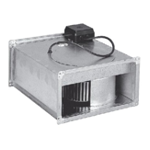
In the category of fans for four-sided ducts, there are mainly fans with the radial impeller construction. These rectangular fans are intended for more complex ventilation applications where higher pressure losses are expected to be overcome. Usually these are not silent fans, but our offer also includes fans with a sound-insulated housing that achieves acceptable noise parameters.
The category of fans for square ducts mainly includes fans with a radial impeller design. These fans are designed for more complex ventilation applications where greater pressure losses are expected. As a rule, these are not quiet fans, but our range also includes fans with noise-insulated housings that achieve acceptable noise parameters.
Fans for square ducts – solutions for demanding ventilation systems
Fans for square ducts are designed for more complex and powerful ventilation systems where higher pressure losses and the need for stable air flow are expected. Most fans in this category have a radial impeller design, which is advantageous for achieving higher static pressure and efficient air transfer.
Our range includes fans for various applications: from industrial and commercial applications to technical and residential ventilation, including noise-insulated models to reduce operating noise.
Quick overview of the range
- All fans
- Fans for square ducts
- High-pressure fans
- Acoustic-insulated fans
- EC energy-saving fans
- Fan accessories
What makes square fans special?
- High static pressure – the radial design ensures stable performance even at higher pressure losses.
- Wide range of models – from lightweight radial fans to powerful units for commercial use.
- Noise insulation – ensures lower noise levels during operation in some models.
- Easy maintenance – fans with a tilting impeller and service door for quick cleaning.
Technical parameters to focus on
When choosing the right fan for square ducts, we recommend focusing on:
- Air flow (m³/h) – the amount of air that the fan is capable of moving.
- Static pressure (Pa) – an important parameter for longer and more complex distribution systems.
- Duct dimensions (mm) – for example, 400×200, 600×300, 800×500, or other variants.
- Noise level (dB(A)) – particularly relevant in residential and office spaces.
- Motor type – AC, EC, or three-phase design depending on the required efficiency and control.
Power control
Fan speed control allows the output to be adjusted to the operational requirements. In some models, control is possible by changing the voltage, while others allow the use of a frequency converter or continuous control for EC motors.
Installation and operation
- Fans can be installed directly into square ducts.
- Models with inspection doors are easier to service.
- For noisier operations, consider fans with insulated enclosures for lower acoustic output.
FAQ – Frequently Asked Questions
What is the difference between radial fans for square ducts?
The difference lies mainly in performance, noise level, and motor type – some models are designed for residential use, others for demanding commercial applications.
What does a soundproof enclosure mean?
A soundproof enclosure has additional acoustic insulation that reduces the noise level of the fan during operation.
For detailed selection instructions, read: How to choose a fan for square ducting .
Axial fans

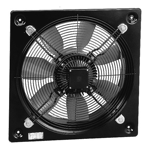
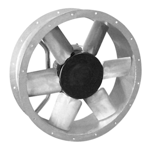
The axial fans are most often used in industrial and agricultural applications. With their impeller design, they achieve high air flow volume. The axial fans are basically divided into wall-mounted and duct-mounted. Recent manufacturers' trends and EU directives contribute to the continuing expansion of our range of EC motor fans, which are easily adjustable. The axial fan range includes fully configurable fans: by turning the blades, by the motor power, by the housing design or by the temperature resistance of the elements used.
Centrifugal fans
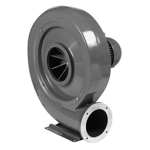
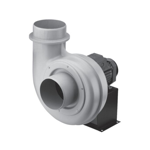
Centrifugal fans are suitable for various industrial applications such as cooling of machines and products. The radial fans are designed for long ventilation ducts with high pressure drop. We supply radial fans for circular and four-sided ducts, insulated, for higher temperatures, for applications from restaurants and kitchens to special industrial applications.Compact fans

Compact fans are designed to be as small and efficient as possible while providing sufficient airflow in a confined space. Compact fans come in a variety of designs - axial, centrifugal and diagonal. They are often used in applications such as electronic equipment, server cabinets, automotive, home appliances and other areas where there is a need to provide cooling or air circulation without taking up too much space. These fans are key to maintaining optimum temperature conditions and ensuring reliable operation of the equipment in which they are installed. They can be mounted in a variety of ways, including surface mount, cabinet mount or panel mount.
The axial compact fans are often used in control cabinets for IT infrastructure. These enclosures have limited space but also require high cooling performance.
The centrifugal compact fans are very efficient in confined spaces while consuming very little power, for this reason they are often used in commercial and residential applications such as fume hoods or smaller industrial vacuum pumps.
The diagonal compact fans achieve higher air output with significantly higher pressure rise and lower noise levels. The diagonal compact fans are used for cooling electrical equipment with high accessibility requirements, for example in important data centres where increasing power demand is required for ICT applications due to the new 5G communication standard, autonomous driving or artificial intelligence.
All three types of compact fans are particularly characterised by their long lifetime and efficiency.
Catalogue sheet: catalog-compact-fans-en.pdf
Roof fans

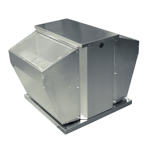
Roof fans are used for ventilation of apartment buildings, workshops, production halls, restaurants and other buildings with both flat and pitched roofs. In the category of roof fans we offer fans that are designed for installation and connection to common ducts of apartment buildings or for ventilation ducts leading to roofs of buildings.
Explosion proof fan

Fans designed for use in explosive environments are suitable for operations where flammable or explosive materials are handled. The explosion-proof fans have an encapsulated electronic part, so there is no risk of sparking due to a short circuit or mechanical damage. The explosion-proof fans are available in many versions for walls and roofs and for both four-sided and circular ducts. All explosion-proof fans supplied by us have the appropriate tests and certificates for operation in the Ex zones.
Explosion-Proof Fans (ATEX) – safe ventilation for hazardous areas
Explosion-proof fans, often referred to as ATEX fans or Ex fans, are designed for exhaust and supply air in facilities where an explosive atmosphere may occur due to flammable gases, vapours, mist or dust. Typical applications include the chemical industry, spray booths, solvent storage, energy facilities, food production, woodworking plants and technologies where combustible dust is generated. A properly selected fan for hazardous areas must match not only the required airflow and pressure, but above all the ATEX classification of the specific operation.
ATEX is not a trade name, but the European framework for equipment and workplaces in explosive atmospheres. For the equipment itself, Directive 2014/34/EU is essential, while workplace safety and zoning are covered by Directive 1999/92/EC. In practice, this means that when selecting a fan, you need to know whether the environment contains gases or dust, which zone the device is intended for and what the requirements are for temperature class, gas group and construction design. Zones are usually classified as 0, 1, 2 for gases and vapours and 20, 21, 22 for combustible dust.
Quick navigation through the explosion-proof fan range
- All fans
- Explosion-proof fans
- CMS ATEX – centrifugal fans for hazardous areas
- EX – explosion-proof centrifugal inline fans
- TCBT Ex – explosion-proof axial inline fans
- E-ATEX – wall-mounted explosion-proof axial fans
- TCDH Ex – explosion-proof roof centrifugal fans
- DKEX – explosion-proof centrifugal fans for round / rectangular ductwork
- RVK – explosion-proof plastic inline fans
- Fan accessories
What really matters when choosing an ATEX fan
With a standard fan, you mainly deal with airflow, pressure loss, noise and installation method. With an explosion-proof fan, several key safety parameters are added:
- ATEX zone – for example zone 1 or 2 for gases and vapours, or 21 or 22 for dust.
- Type of medium – whether it is gases, vapours, mist or explosive dust.
- Gas group – typically IIA, IIB or IIC; some applications also require a design for hydrogen.
- Temperature class – for example T3 or T4, i.e. the maximum permissible surface temperature of the equipment.
- Required airflow (m³/h) – for ventilating a space or a technological device.
- Static pressure (Pa) – important especially in duct runs, filters, dampers, silencers and complex distribution systems.
- Construction design – axial, centrifugal, roof, wall-mounted or inline solution.
- Material design – for example steel, aluminium, silumin or plastic according to the medium and chemical resistance.
How to read ATEX marking on a fan
On product ranges you may encounter a designation such as II 2G Ex h IIB+H2 T3 Gb. In simplified terms, this means that the equipment is intended for industrial use outside mining environments, for a gaseous atmosphere of a certain category, in a specific gas group and with a defined maximum surface temperature. On your e-shop, this marking is explicitly stated for example for the DKEX and RVK ranges, where it is also stated that they are certified for hydrogen.
Centrifugal, axial, roof or wall-mounted Ex fan?
The choice of construction depends on the application. Centrifugal explosion-proof fans are suitable where pressure losses are higher and the duct system is more complex. This is typical for extraction from technological lines, spray booths, filtration units or longer HVAC runs. By contrast, axial explosion-proof fans are suitable where you need high airflow and lower pressure losses, for example for direct exhaust or supply air. Roof Ex fans are used to ventilate buildings through the roof and wall-mounted explosion-proof fans are suitable for direct wall installation.
Main advantages of explosion-proof fans
- Safe operation in ATEX environments – the fans are designed for use in facilities with explosion risk.
- Correct Ex design for a specific hazard – according to zone, medium, gas group and temperature class.
- Wide range of constructions – centrifugal, axial, inline, wall-mounted and roof models.
- Solutions also for special applications – including ranges certified for hydrogen.
- Durability for demanding industrial operation – a design adapted to technical and manufacturing applications.
Typical applications of explosion-proof fans
- spray booths, painting cabins and solvent extraction
- chemical and petrochemical operations
- technologies with the presence of flammable gases and vapours
- extraction of explosive dust in food production and woodworking
- chemical storage, battery rooms, hydrogen applications and technical rooms
Installation, control and service in ATEX mode
With explosion-proof fans, selecting the correct model is not enough. Proper installation, grounding, the choice of compatible accessories and compliance with all project requirements for hazardous areas are equally important. If speed control is used, it must also be suitable for the specific Ex design. For more complex applications, it is therefore advisable to select the fan together with a designer or technician who has information about the zone, medium, temperature, pressure loss and operating mode.
FAQ – frequently asked questions
What is an explosion-proof fan?An explosion-proof fan is a fan designed for operation in environments where an explosive atmosphere can be created by flammable gases, vapours or dust. The construction and marking of the equipment must comply with ATEX requirements.
What is the difference between a standard fan and an ATEX fan?A standard fan is not intended for hazardous areas. An ATEX fan must match a specific zone, medium group and temperature class, and its construction must minimise the risk of ignition.
What data do I need for the correct selection?For a correct design, you need to know at least the ATEX zone, the type of medium, the required airflow, the pressure loss, the medium temperature and the preferred installation method. Without this information, the fan cannot be selected safely or correctly.
Are there also fans for hydrogen on the website?Yes. For some ranges, for example DKEX and RVK, the website states that they are also certified for hydrogen.
We also recommend publishing a detailed guide as a separate article: How to Choose an Explosion-Proof Fan (ATEX)
Fans for agressive media

Acid-resistant fans can handle the suction of air and vapors containing heavy corrosive gases or other chemically aggressive substances. The fans are made of materials such as polypropylene or UV resistant polyethylene. The acid-proof fans are used for exhausting air in testing rooms, sewage disposal plants, tank towers, laboratories, chemical industry, food processing industry, etc.
Ceiling fans

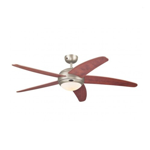
The luxury design and industrial ceiling fans are tuned to the last detail. The unique construction processing of each ceiling fan is a matter of course as well as a sophisticated design for demanding customers. The ceiling fans are available with or without light. The ceiling fans have different propeller diameters depending on the size of the space. The fans can be controlled by a chain or a remote control or a wall remote controller. We offer design ceiling fans for home use, for small rooms as well as industrial fans for use in warehouses or other industrial buildings with high ceilings.
Smoke extract fans
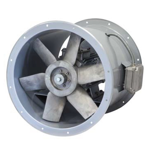
Fire fans are an important part of the building security. In case of a spreading fire, they ensure the removal of dangerous fumes, heat and smoke. The smoke extract fans can operate at temperature of 400 °C for 2 hours, greatly increasing the chances of saving lives. The fans are suitable for fire ventilation of restaurants, hospitals, sports halls and warehouses.
Transport fans

The transport fans are designed for extraction of coarse and loose materials such as sawdust, woodchips, grain and for air extraction during grinding, welding, etc. The transport fans find their application mostly in the engineering and agricultural industry, but their resistance will be appreciated also by the operators of small and medium-sized workshops.
The fans are designed to achieve high vacuum values. Due to the spheres and applications where the transport fans are used, the Transfer ducts or the Flexadur and Ventitec flexible hoses for the extraction of abrasive materials are most often used as recommended accessories, depending on the content and temperature of the extracted air.